

How Does MPPT Affect Solar Charging for Portable Power Stations?
How Does MPPT Affect Solar Charging for Portable Power Stations?
From the physics, to real-world efficiency, to what to check before you buy in 2026
Updated: September 2026
If you charge a portable power station with a solar panel, you've almost certainly seen the term MPPT — Maximum Power Point Tracking — in the spec sheet. It isn't a throwaway marketing acronym; it's the component that determines how many watt-hours the exact same panel, under the exact same sky, actually delivers to the battery. This article explains, with as little math as possible, what MPPT actually does, how it changes charging speed and battery health, and what's new in this technology heading into late 2026.
1. What MPPT Actually Does
A solar panel is not a constant-voltage source. Its output voltage and current shift continuously with sunlight intensity, temperature, and shading. At any given instant, only one specific voltage/current combination lets the panel output its maximum possible power — that point is called the Maximum Power Point (MPP).
Without smart control, the charging circuit is often clamped by the battery's voltage — the panel is forced to operate at whatever voltage the battery demands, not the voltage at which the panel itself is most efficient. That's how older PWM (Pulse Width Modulation) controllers work: they switch on and off, dragging the panel's voltage down toward the battery voltage.
An MPPT controller works completely differently. It samples the panel's voltage and current at millisecond intervals, uses an algorithm (commonly Perturb & Observe, Incremental Conductance, or, more recently, adaptive algorithms that borrow techniques from machine learning) to locate the maximum power point in real time, then runs that power through an efficient DC-DC buck/boost stage to match the voltage and current the battery needs. In short, MPPT keeps the panel working at its most efficient point instead of making it work at whatever point the battery happens to prefer.
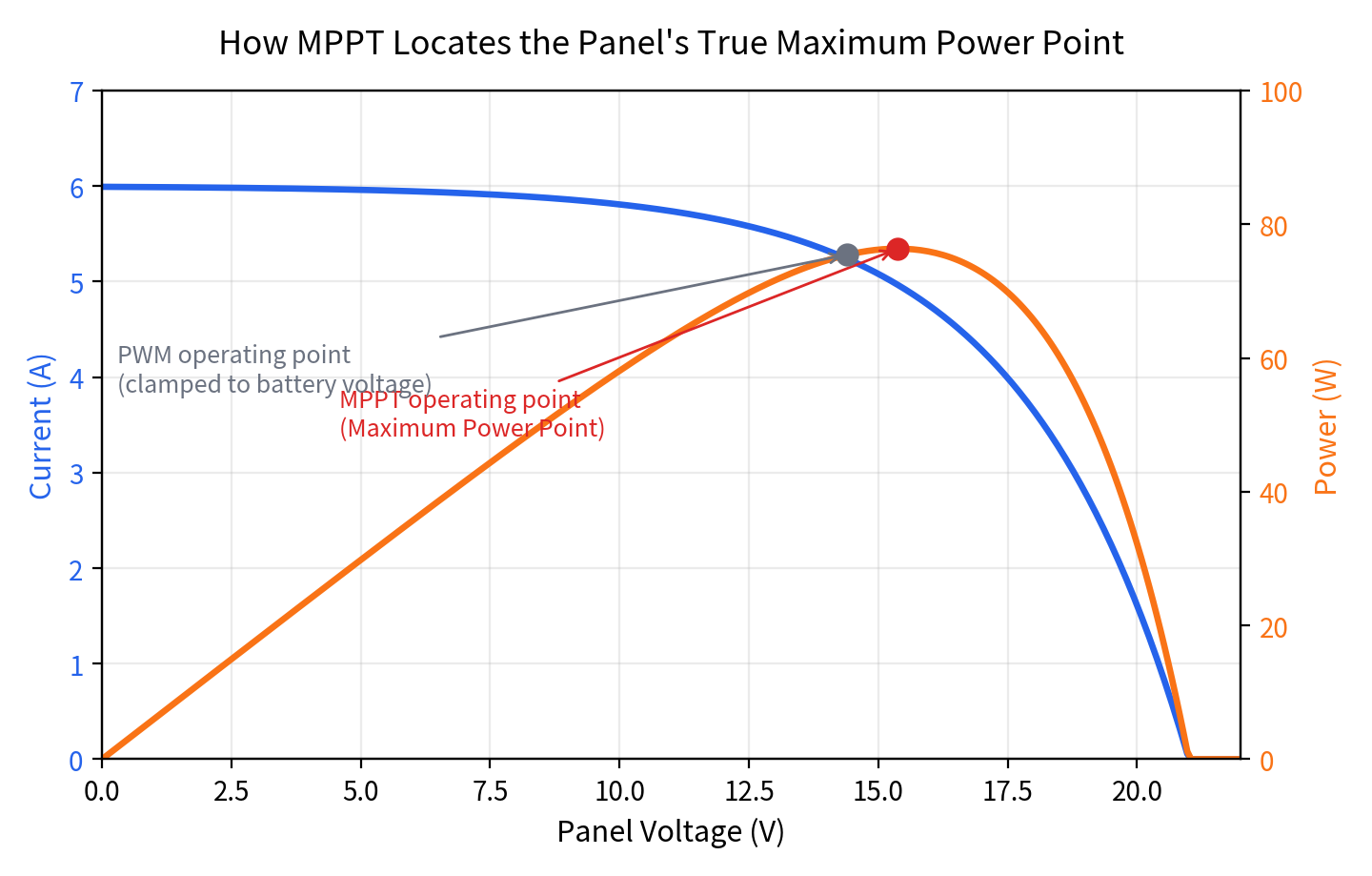
Figure 1: I-V / P-V curve — MPPT locates the true maximum power point, while PWM's operating point is dragged down by the battery voltage.
2. How MPPT Specifically Affects Solar Charging on a Power Station
2.1 Charging speed: the 15%-30% gain is real
Multiple independent reviews and industry sources report that MPPT typically captures 15%-30% more solar energy than PWM, with the exact gain depending on the voltage gap between panel and battery, temperature, and lighting conditions. This isn't a marketing exaggeration — it comes directly from the operating-point difference described above: the bigger that gap, the bigger MPPT's advantage.
2.2 Cold, high-voltage conditions: extra voltage stops going to waste
A solar panel's open-circuit voltage rises in cold weather. On a PWM system, that extra voltage is largely wasted, and may even trigger current-limiting protection. An MPPT controller instead converts that surplus voltage into extra current, pushing more power into the battery — which is why many users see higher charging wattage from an MPPT-equipped power station on cold, clear days than the panel's rated wattage alone would suggest.
2.3 Partial shading and cloudy weather: more resilient, but not magic
A single MPPT channel still outperforms PWM when a panel is partly shaded by a tree or cloud, but when several panels are wired together under uneven shading, a traditional single-channel MPPT controller can lock onto a local power peak instead of the true global maximum. This is exactly why a growing number of premium power stations now use multi-channel MPPT designs — letting each solar input hunt for its own optimum independently, so one shaded panel doesn't drag the others down.

Figure 2: MPPT's energy-harvest advantage over PWM across lighting/temperature conditions (illustrative figures showing the general trend; actual numbers vary by product).
2.4 Battery life: a smoother charging curve
MPPT controllers typically work together with the battery management system (BMS) to execute a more precise constant-current/constant-voltage charging profile, reducing the risk of over- or under-charging caused by voltage swings — something several manufacturers and reviewers link to longer cycle life for LiFePO4 battery packs.
3. PWM vs. MPPT at a Glance
|
Aspect |
PWM Controller |
MPPT Controller |
|
Working principle |
Switches on/off, directly clamps panel voltage to battery voltage |
Continuously scans the I-V curve, dynamically finds the max power point, then converts |
|
Typical efficiency |
~65%-75% (varies more with conditions) |
~92%-98% |
|
Cold / high-voltage conditions |
Extra voltage is wasted, or current is limited for protection |
Extra voltage is converted into current for faster charging |
|
Partial shade / cloudy |
Efficiency drops noticeably; output falls fast |
Holds up better (varies by product and shading pattern) |
|
Hardware cost |
Lower |
Higher (usually recovered within a year via extra energy harvested) |
|
Best for |
Small, budget-first, simple setups |
Portable power stations, RVs, camping; standard on most mainstream brands |
4. The Solar Charging Path, Visualized
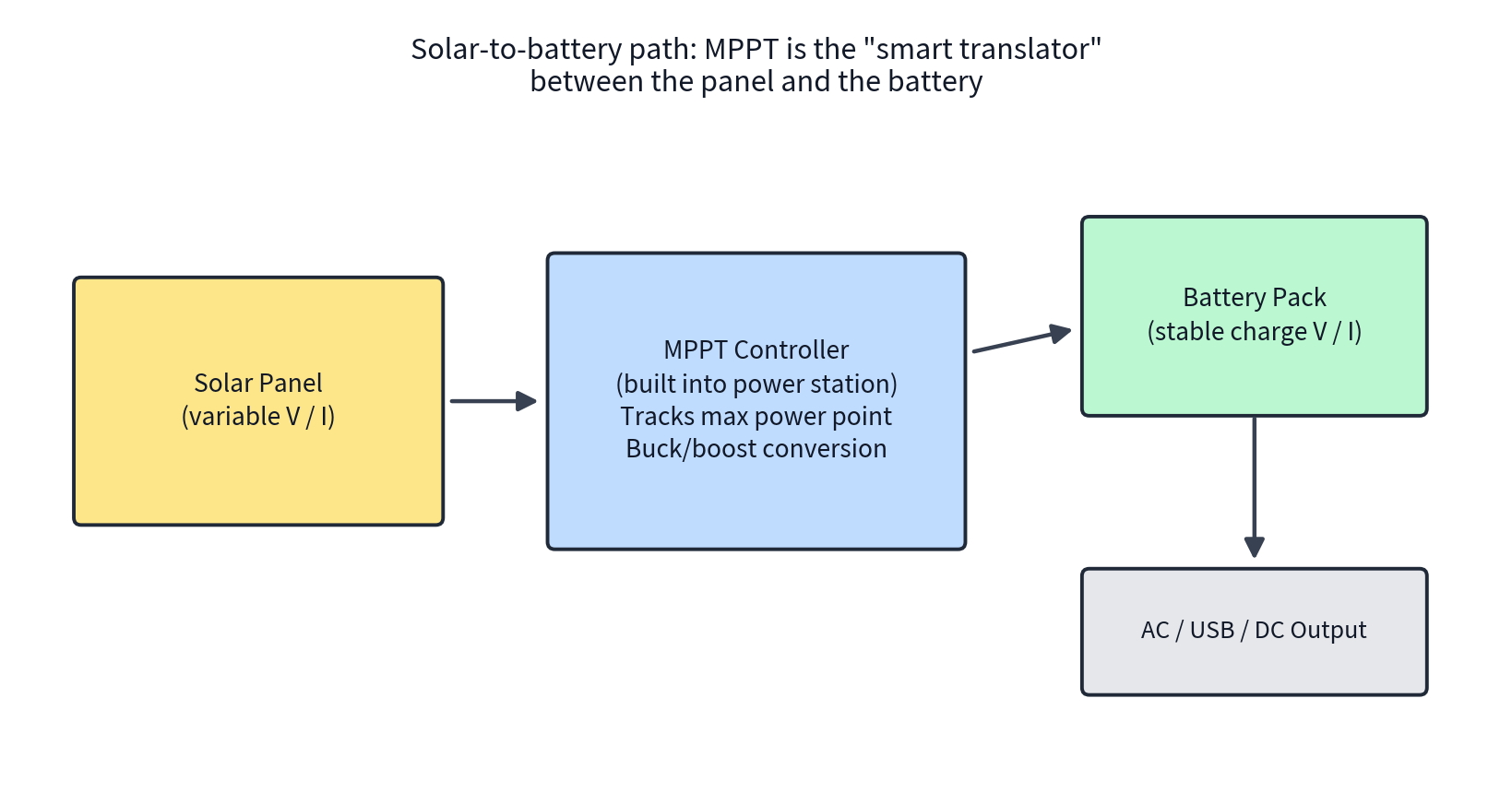
Figure 3: The complete solar-to-battery path in a portable power station — MPPT is the "smart translator" between the panel and the battery.
5. What's New in 2026
Heading into late 2026, a few trends are worth watching in MPPT for portable power:
- Independent multi-channel MPPT: for setups combining several panels at different angles or under uneven shade, newer power stations and premium controllers give each solar input its own MPPT chip, avoiding the "weakest panel drags down the rest" problem.
- App and Bluetooth monitoring: most mainstream brands now ship controllers with Bluetooth/app monitoring, showing live panel voltage, current, and daily yield curves on your phone — handy for deciding whether to re-angle a panel.
- Wider input voltage windows: many 2026 models extend the solar input range to roughly 11V-60V or beyond, improving compatibility with third-party panels and series/parallel arrays.
- Algorithms keep improving, but edge cases still exist: user communities have reported MPPT tracking instability in specific cases — for example, when a panel array's current significantly exceeds a controller's rated current, some units show voltage jumps or appear to track current rather than true power. This is a reminder to check that your panel array's voltage and current fall within the controller's rated range, not just whether it "supports MPPT."
|
Quick checklist before buying an MPPT-equipped power station 1. Does the solar input voltage range cover your panel's open-circuit voltage in cold weather? 2. Does the solar input wattage limit comfortably cover the total wattage of the panels you plan to pair with it? 3. If you'll run multiple panels, does it offer multi-channel MPPT or at least decent partial-shading resilience? |
6. Bottom Line
MPPT isn't a nice-to-have spec — it's the component that determines how much of your panel's potential actually reaches the battery, how fast that happens, and, over time, how long the battery lasts. Compared with PWM, it recovers extra energy in almost every lighting and temperature condition, with the biggest gains showing up in cold, high-voltage, and partially shaded scenarios. The direction of travel for 2026 is finer-grained multi-channel tracking, more transparent app monitoring, and wider voltage compatibility — but it's still worth checking a controller's rated input range against your actual panel setup, since tracking algorithms can behave unpredictably at the edges of their spec.
This article draws on public reviews and industry sources; refer to manufacturer testing and official specifications for exact performance figures of any specific product.