

Rated Power vs. Peak Power in Portable Power Stations: What Is the Difference?
TECHNICAL EXPLAINER
Rated Power vs. Peak Power in Portable Power Stations: What Is the Difference?
News and data current to September 2026
|
Key takeaways
|
1. What the two numbers mean
On a spec sheet the AC output is often written as “1000 W (2000 W peak)”: the first figure is rated power, the second is peak power. Both are in watts (W) but describe different abilities. Battery capacity (Wh) is a third, independent figure: it sets how long the station runs, not how large a load it can carry.[1]
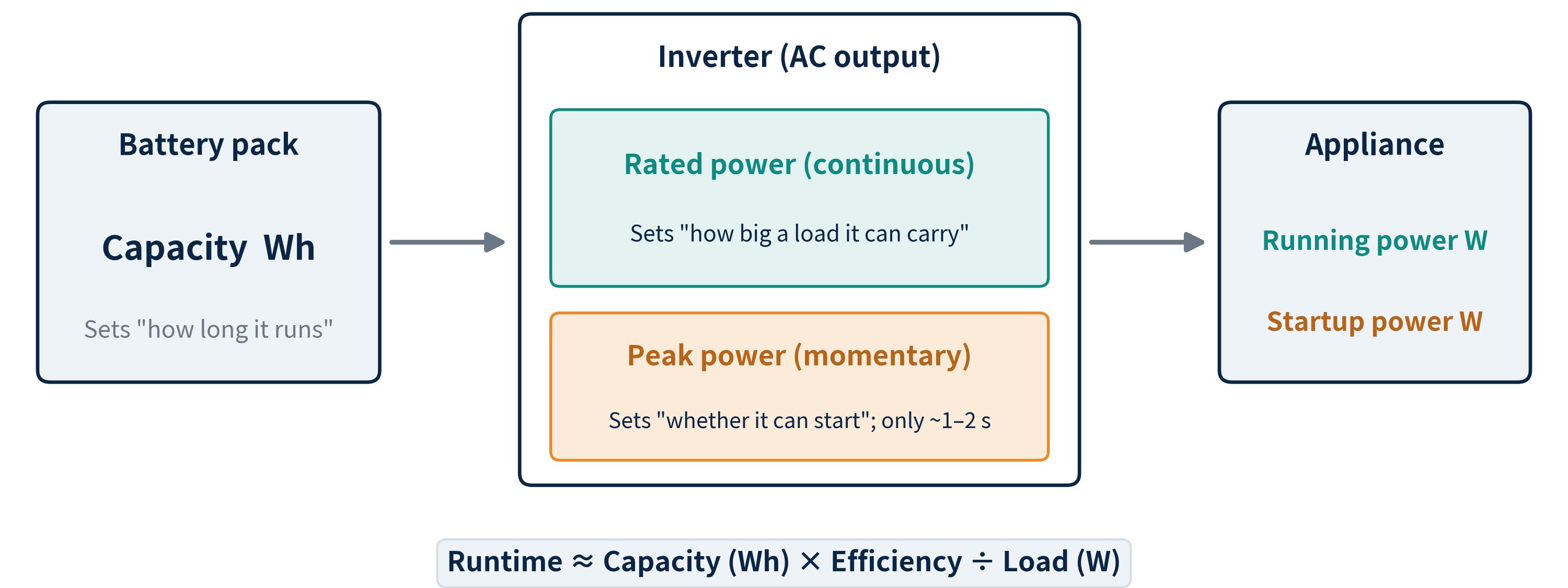
Figure 1 Roles of the three core specs: capacity = how long, rated = how big, peak = whether it starts
Table 1 Rated power vs. peak power
|
Item |
Rated power (continuous) |
Peak power (momentary / surge) |
|
Meaning |
Limit the inverter holds for long periods |
Maximum output it withstands briefly |
|
Duration |
Long, limited by charge and temperature |
Usually only ~1–2 s, often under 1 s [3][4] |
|
Decides |
How much load can run at the same time |
Whether motor or compressor loads can start |
|
Vs. rated |
— |
Typically ~1.2–2× rated; varies by brand [1][6][12] |
|
If exceeded |
Overload protection, derating or shutdown |
Start-up fails; inverter protection trips |
2. Why two numbers exist: motor start-up as an example
Motor-driven (inductive) loads such as fridge compressors and water pumps must build a magnetic field and spin up the rotor at start, so current is typically 3–7 times the running current before it quickly falls back to the running level.[3][4][9] From an engineering view, inverter heating builds up over time, so the inverter can exceed its continuous limit for a very short moment but not for long, which is why makers print two figures.
Take a station rated 1000 W with 2000 W peak (Figure 2). A small fridge compressor runs at about 150 W and needs about 1200 W to start; that exceeds the rated power but stays below the peak, so it starts normally [6][7]. A water pump running at 300 W needs a further ~3381 W at start-up, for about 3681 W in total; that exceeds the peak, so the inverter trips its protection and the start fails [3].
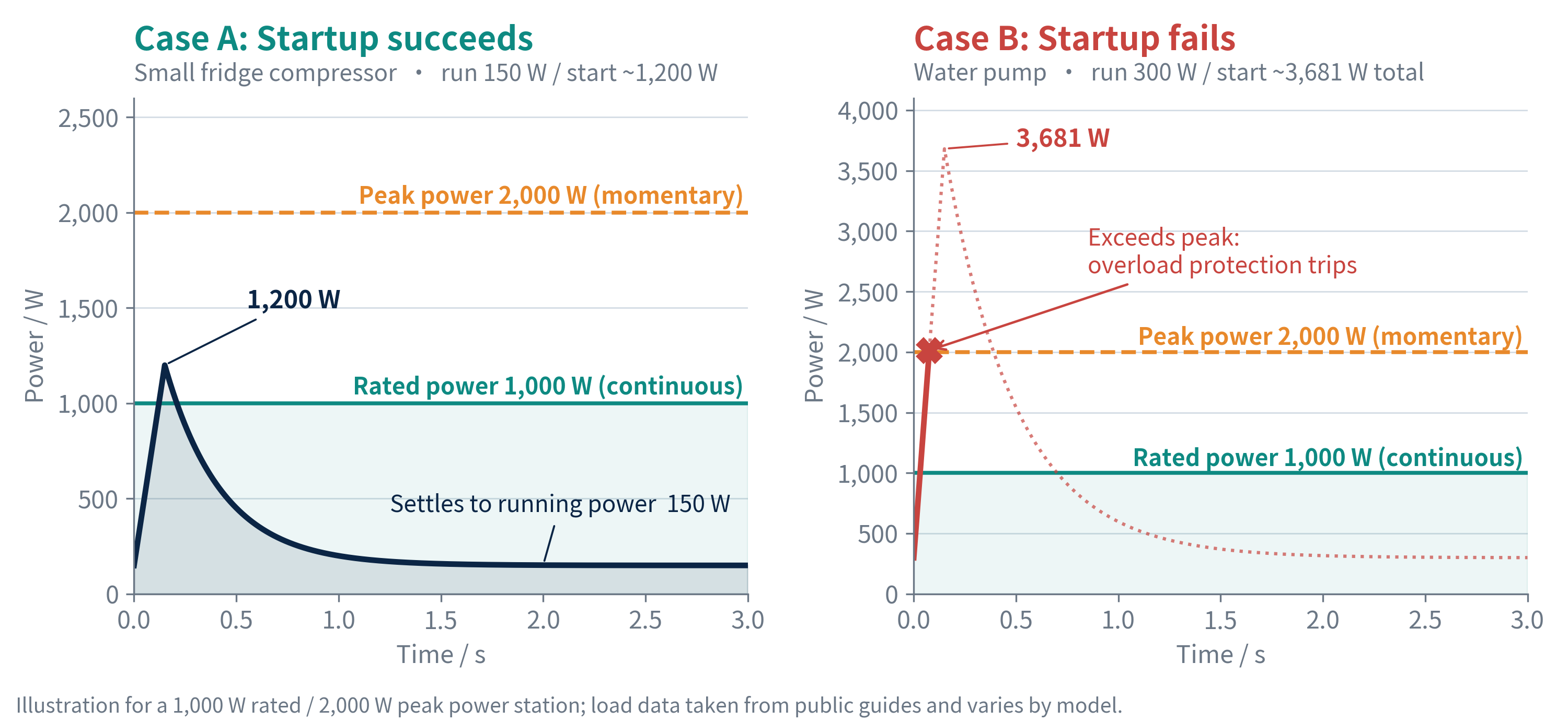
Figure 2 The same station (1000 W rated / 2000 W peak) with two motor loads: start-up demand below peak succeeds, above peak trips protection
Figure 3 adds more comparisons: start-up power of motor loads can reach 2× to over 12× running power and varies by product, so no fixed multiplier can be assumed; use the appliance nameplate or manual.[3][7]

Figure 3 Running vs. startup power of motor loads (log scale; data from public sizing guides, order of magnitude only)
3. Load type decides which spec to check first
Table 2 Load type and key spec
|
Load type |
Typical devices |
Startup power |
Check first |
|
Resistive (heating) |
Hair dryer, kettle, electric blanket, space heater |
≈ running power |
Rated power |
|
Electronics |
Phone, laptop, router, projector |
Close to running power |
Rated power (total) |
|
Inductive (motor) |
Fridge, pump, air compressor, power tools |
~2–12× running power |
Peak + rated power |
A classic trap: a 1200 W space heater is a resistive load that needs 1200 W continuously. On a station rated at only 1000 W it will not run, even if the peak is listed at 2000 W.[4]
4. Latest developments in 2026
- Rated output keeps rising. Solar Waypoint’s 2026 market analysis finds a median inverter of 1800 W in the 800–1300 Wh class, with about 65% of models at or above that level.[5]
- Similar capacity, very different power. Among 2026 launches, the DJI Power 1000 Mini (1008 Wh) offers 1000 W AC output, the EcoFlow DELTA 3 Classic (1024 Wh) offers 1800 W, and the DELTA 3 1000 Air (950 Wh) only 500 W.[8] Do not size by Wh alone.
- No common basis for peak figures. Makers may quote conventional surge, “boost” modes or proprietary start-up capability, each under different conditions and durations; Solar Waypoint therefore uses continuous AC output as its cross-brand metric.[5] When comparing brands, rely mainly on rated power and treat peak as a per-product reference.
- Boost output modes. Some brands offer modes such as X-Boost or “dimension-raising drive” that are claimed to let a 300 W-rated unit run about 600 W heating appliances (e.g. a small rice cooker or electric blanket).[10] These modes target resistive loads, and the appliance’s actual heating power is below its nameplate value; they do not raise the rated or peak power, so follow the maker’s list of supported devices.
5. A four-step sizing method
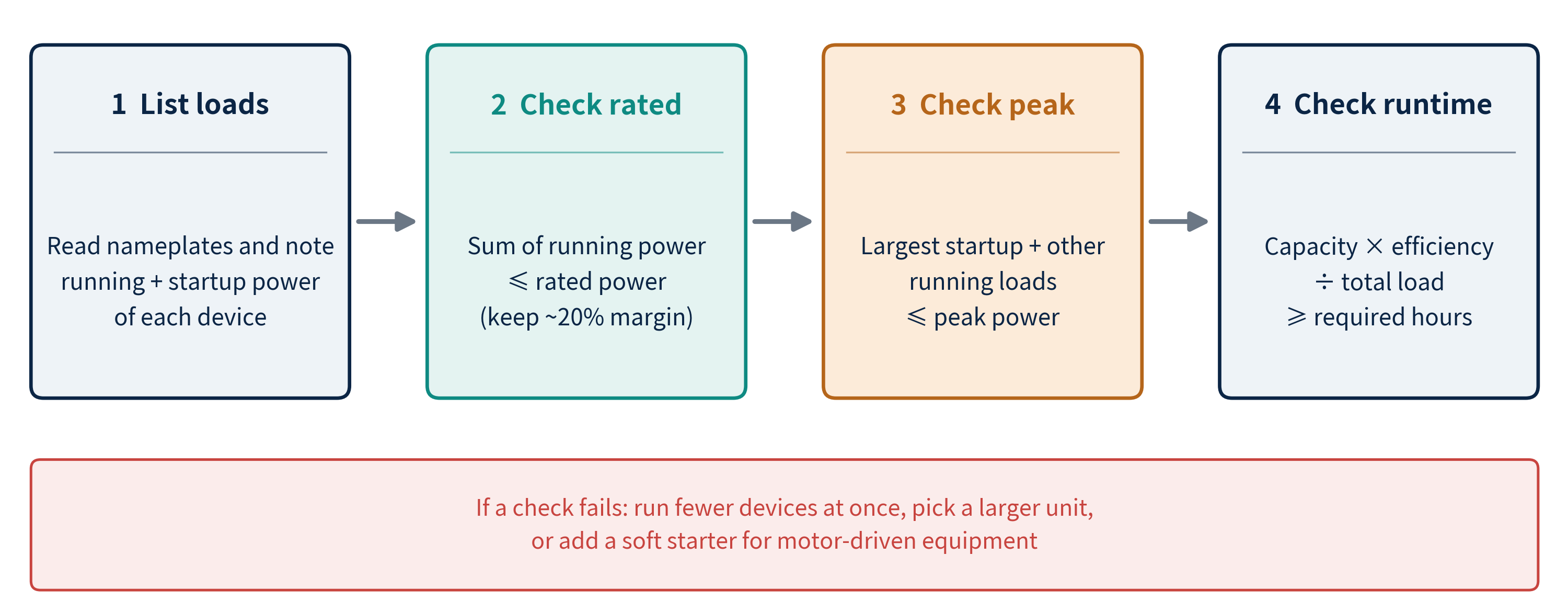
Figure 4 Power sizing workflow for a portable power station
Table 3 Reference values for typical devices (vary by model; check the nameplate)
|
Device |
Running power |
Startup power |
Type |
|
Laptop |
~50 W [11] |
Close to running power |
Electronics |
|
Space heater |
~1200 W [4] |
Close to running power |
Resistive |
|
Hair dryer |
~1600 W [10] |
Close to running power |
Resistive |
|
Small fridge |
~150 W [7] |
~1200 W [7] |
Inductive |
|
Water pump |
300 W [3] |
~3681 W (incl. running) [3] |
Inductive |
Example. A camper runs a small fridge (150 W, ~1200 W at start), LED lights (20 W), a laptop (60 W) and phone charging (15 W). Running power totals 245 W; with the common practice of keeping ~20% margin, rated power should be at least about 310 W. The largest start-up demand is about 1200 + 95 = 1295 W, so peak power should exceed that. If everything ran for 8 hours, about 245 W × 8 h ÷ 0.85 ≈ 2300 Wh would be needed (a real fridge cycles on and off, so actual use is lower). This is consistent with the usual entry-level advice of ≥ 500 W rated and ≥ 1500 W peak.[2][7][9]
6. Common misconceptions
- Treating peak as sustained capacity. A unit labelled “200 W / 400 W peak” cannot run a 400 W device continuously.[1]
- Ignoring stacking. Peak power must cover the start-up moment plus every other load already running, not just one device’s start-up.[3]
- Leaving no margin. Consumer Reports advises leaving headroom between total appliance wattage and the station’s maximum, because fridges and similar loads surge when they cycle.[2]
- Comparing peak figures across brands. Test conditions and durations are not standardized, so prioritize rated power and the official list of supported devices.[5]
Conclusion
Rated power answers “can it keep carrying the load”; peak power answers “can it start the load”. List each device’s running and startup power, satisfy rated power first, verify peak second, and use capacity to work out runtime; that avoids most cases of buying too much or too little.
References
[1] FlashFish, Running Watts vs Surge Watts for Portable Power Stations, 2026-06-25. https://www.flashfishtech.com/blogs/energy-guide/running-watts-vs-surge-watts-portable-power-station
[2] Consumer Reports, Best Portable Power Stations of 2026. https://www.consumerreports.org/home-garden/generators/best-portable-power-stations-a4748703075/
[3] GeneratorChecker, Surge Watts vs Running Watts: The Complete Guide, 2026-04-21. https://generatorchecker.com/guides/surge-watts-explained/
[4] BackupPowerHub, Portable Power Station Features Guide, 2026-07-09. https://backuppowerhub.com/portable-power-station-features-guide/
[5] Solar Waypoint, How Portable Power Stations Are Getting More Powerful, 2026. https://www.solarwaypoint.com/portable-power-station-power-capacity-trends/
[6] WalkingSolar, Portable Power Station Buying Guide 2026, 2026-03-02. https://walkingsolar.com/portable-power-station-buying-guide-how-to-choose-the-right-one-in-2026/
[7] Lokahi Health Center, What Do You Actually Need to Power?, 2026-06-25. https://www.lokahifcu.com/learn/news/better-together-blog/blog/2026/06/25/what-do-you-actually-need-to-power--a-simple-guide-to-picking-the-right-portable-power-station
[8] 充电头网,2026新款户外电源汇总,2026-06-02. https://www.chongdiantou.com/archives/1780381534757.html
[9] 知乎专栏,户外电源避坑指南(感性负载启动电流、逆变效率). https://zhuanlan.zhihu.com/p/362749281
[10] 知乎专栏,2026年推荐5款品牌高性价比户外电源(升维驱动、电吹风功率). https://zhuanlan.zhihu.com/p/702090823
[11] Joybuy,2026 年户外电源推荐:专业选购的技术标准. https://www.joybuy.de/blog/huwai-dianyuan-xuangou-zhinan-2026/8YfEleqb
[12] 搜狐,2026年户外移动电源性价比推荐(额定/峰值示例). https://www.sohu.com/a/1078389396_122471764
Data come from the public sources above; example values only illustrate the principle. Always follow the product nameplate and official manual. Searched on 2026-09-21.