

How Long Does a 1000Wh Power Station Last? How to Calculate Real-World Runtime for Every Device
How Long Does a 1000Wh Power Station Last?
How to Calculate Real-World Runtime for Every Device
A 2026 guide with the latest test data and a repeatable calculation method
The most common question about a 1000Wh (1kWh) portable power station is simple: "how long will this actually last?" The honest answer is: it depends entirely on what you plug in. It might keep phones charged for a week, or drain in under half an hour running an induction cooktop. This guide gives you a repeatable formula, backed by 2026 industry test data, to turn that uncertainty into a number you can actually plan around.
1. Two numbers you need to understand first: Wh and W
Every power station label carries two different units, and mixing them up is the single most common mistake buyers make:
- Watt-hours (Wh) measure stored energy — the size of the fuel tank. A 1000Wh unit can theoretically run a 100W load for 10 hours, or a 500W load for 2 hours.
- Watts (W) measure output power — the size of the engine, and they set the ceiling on what you can run at all. A station rated for 300W continuous output simply cannot start a 1200W microwave, no matter how full the battery is; it will shut down protectively instead.
The conversion between the two: Wh = Ah x V. A 1000Wh battery pack could be a 12V system with roughly 83.3Ah, or a 24V system with roughly 41.7Ah.
2. The formula that actually predicts real-world runtime
A naive "capacity divided by wattage" calculation overstates real-world runtime, because two things eat into usable energy: the depth of discharge (DoD) the battery management system reserves to protect cell life, and the conversion loss of the inverter as it turns DC battery power into AC output. The formula used across the industry is:
Runtime (hours) = Rated capacity (Wh) x Depth of Discharge x Inverter efficiency (eta) / Device power draw (W)
For a typical LiFePO4 1000Wh station with a 90% usable DoD and an 85% inverter efficiency, the real usable AC energy works out to:
- 1000Wh x 0.90 (DoD) x 0.85 (inverter efficiency) is approximately 765Wh of usable energy
In practice, a station rated at "1000Wh" typically delivers somewhere around 850 to 900Wh at the outlet under light loads, and that gap widens further at higher loads where inverter efficiency drops — a pattern confirmed by independent testing of multiple 2026-era 1000Wh-class units. The chart below illustrates where that energy goes:

Figure 1: Where the energy goes — from rated 1000Wh to usable output
3. Four variables that determine your real runtime
3.1 Inverter efficiency and load size
Inverter efficiency is not a fixed number — it's a curve that changes with load. Most units are most efficient near full load (often above 90%), but at very light loads (say, a single 5W lamp), the station's own idle draw becomes a much larger share of total consumption, and real efficiency can drop to 60-70%. That's why manufacturers recommend testing usable capacity at loads close to 1000W — it produces a far more realistic number than testing with a trickle load.
3.2 Depth of discharge and battery protection
To extend battery life, most brands don't discharge cells all the way to 0%; they hold back a protective margin, typically 5-10% of rated capacity. This is one reason why two "1000Wh" stations from different brands can show slightly different usable capacity in real testing.
3.3 Battery chemistry: LiFePO4 is now the default
Across the 1000Wh class in 2026, LiFePO4 (LFP) chemistry has largely displaced older NMC (nickel-manganese-cobalt) lithium chemistry, mainly because of cycle life. LFP cells typically deliver 2,000-3,000 charge cycles before dropping to 80% of original capacity, versus roughly 500-800 cycles for NMC — meaning LFP can last four to six times longer for anyone who uses their station regularly.
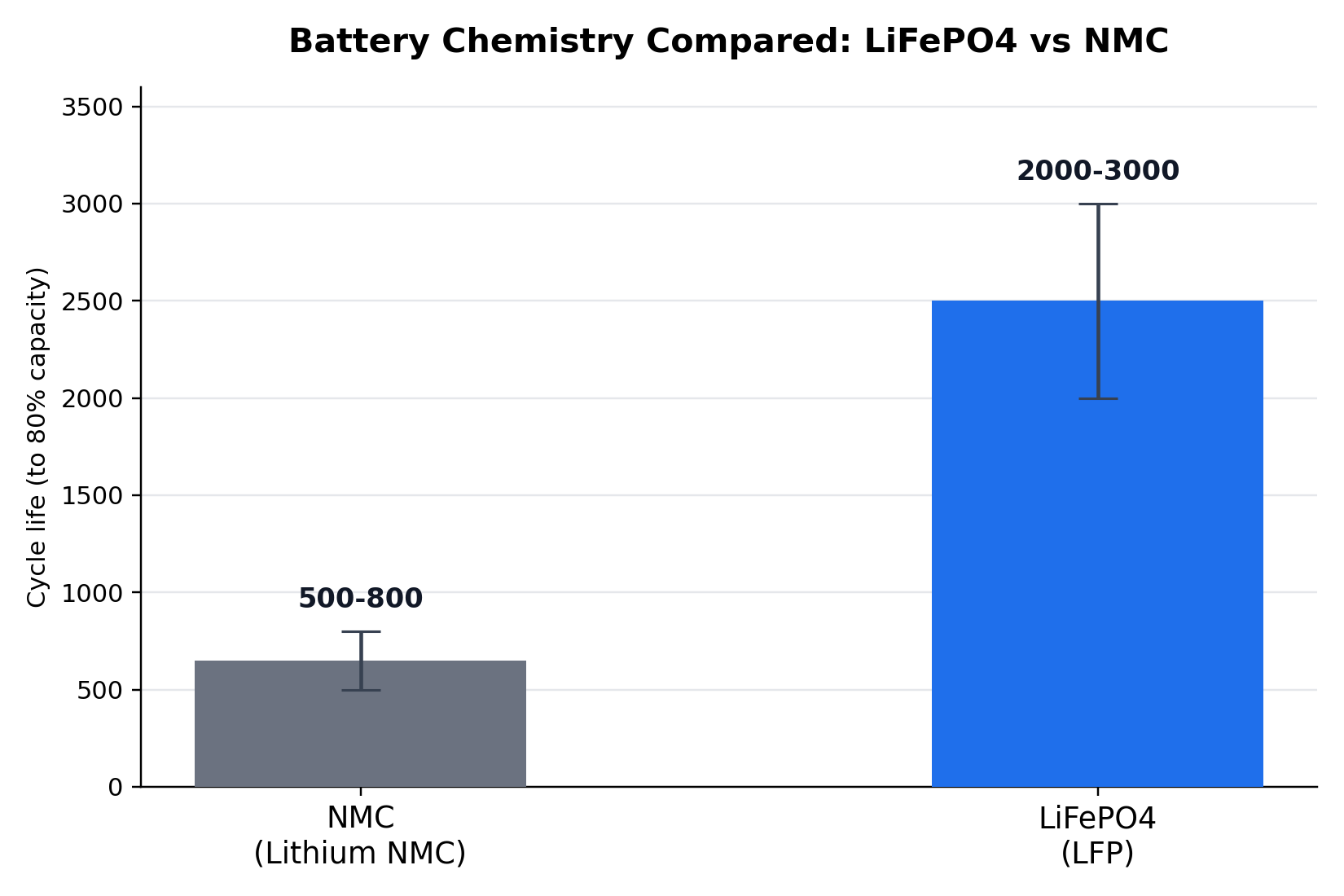
Figure 2: Cycle life comparison, LiFePO4 vs. NMC
3.4 Ambient temperature and idle self-consumption
Cold weather measurably reduces both usable capacity and charge/discharge efficiency — real-world runtime in cold conditions can come in 10-20% below room-temperature test figures. On top of that, the station itself continuously draws a small amount of power for its display, fans, and standby electronics; that "hidden" overhead matters most during long, low-power sessions.
4. Real-world runtime by device
The table below applies a conservative 90% DoD and 85% inverter efficiency (about 765Wh usable) combined with published industry test data, and can be used as a planning baseline:
|
Device |
Typical draw |
Est. runtime |
Basis |
Notes |
|
Smartphone charging |
~15Wh/charge |
~55-60 charges |
1000x0.9x0.85/15 |
Enough for a whole family for days |
|
Laptop |
45-65W |
~12-15 hours |
1000x0.9x0.85/60 |
Based on continuous 60W adapter draw |
|
55" LED TV |
80-120W |
~7-9 hours |
1000x0.9x0.85/100 |
OLED TVs draw more, shortening runtime |
|
Mini/car fridge |
40-60W avg |
~13-19 hours |
1000x0.9x0.85/40 |
Average power incl. compressor cycling |
|
Standard kitchen fridge |
100-200W avg |
~6-10 hours |
Industry test data |
Outage scenario; includes compressor surge |
|
CPAP (no heated humidifier) |
~30W |
~7-8 nights (8h/night) |
1000x0.9x0.85/30/8 |
LiFePO4's silent operation suits bedside use |
|
CPAP (with heater) |
~60W |
~3-4 nights |
1000x0.9x0.85/60/8 |
Heater roughly doubles draw, halving nights |
|
Drone battery charging |
~90Wh/charge |
~8-9 charges |
1000x0.9x0.85/90 |
Most stations only support slow charging |
|
Induction cooktop / rice cooker |
1200-1800W |
~0.4-0.6 hours |
1000x0.9x0.85/1500 |
Very fast draw; check the rated wattage ceiling |
|
LED lamp / lighting |
5-15W |
~50-130 hours |
1000x0.9x0.85/10 |
An ideal choice for emergency lighting |
The same data visualized below (log scale on the horizontal axis, so low- and high-power devices can be compared on one chart):
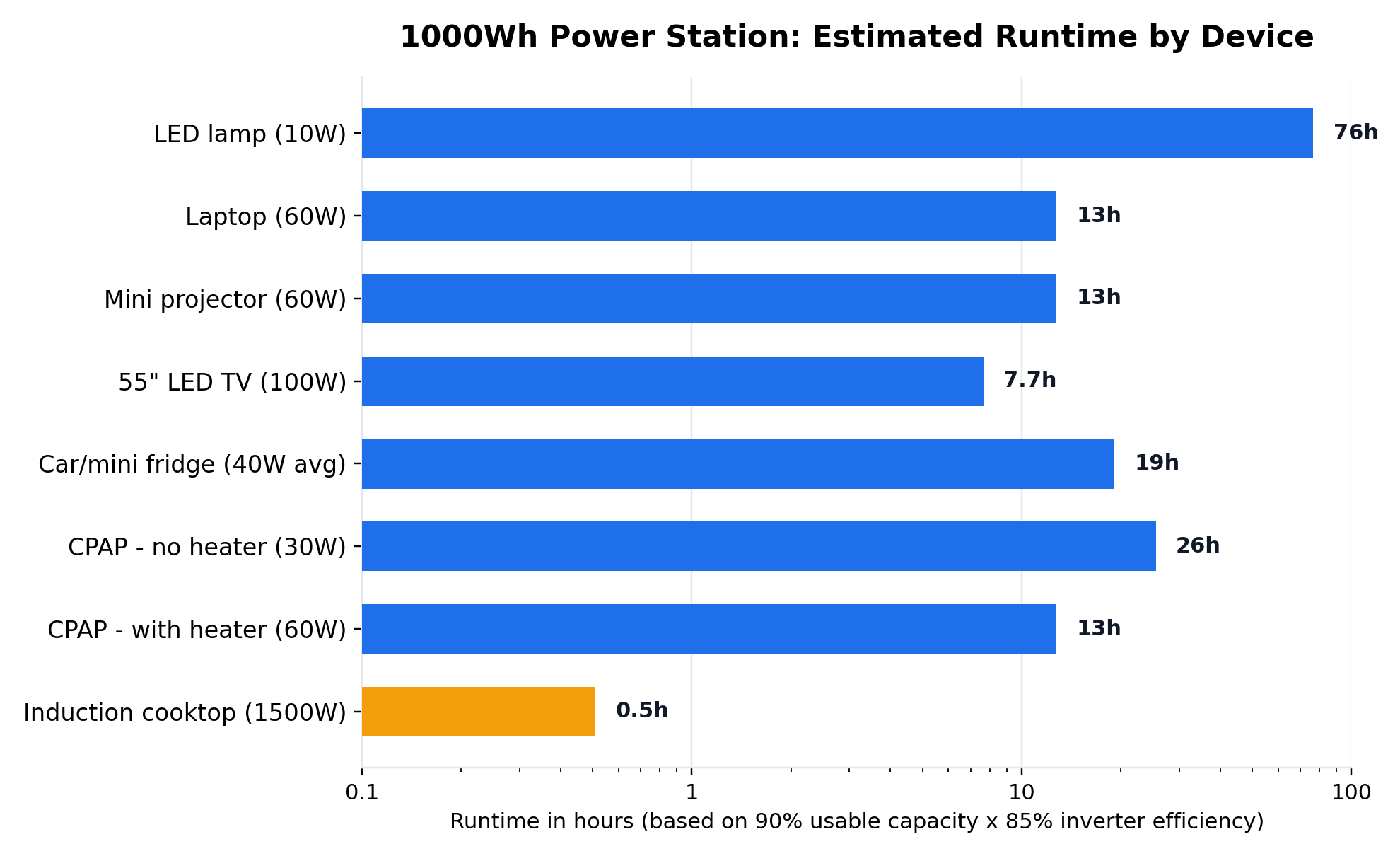
Figure 3: Estimated runtime of a 1000Wh station across common devices (log scale)
5. What's new in 2026
- LiFePO4 is now standard: safer and longer-lasting than legacy NMC chemistry, LFP has become the default for the 1000Wh class, with NMC increasingly phased out of this capacity tier.
- Much faster charging: several 2026 models now offer roughly 1-hour full recharge, paired with more efficient AC/DC conversion stages that address the traditional "slow to refill" complaint.
- Smarter, app-connected units: current-generation stations widely pair their battery management system with a companion app showing remaining charge, per-device draw, cycle count and battery health, and many now include UPS/EPS-style uninterruptible switchover measured in milliseconds.
- Higher energy density: improvements in cell materials and pack design continue to shrink the weight and size of units at a given capacity, meaningfully improving portability.
6. Buying and usage tips
- Size by your device list, not by the biggest Wh number: list what you actually plan to run and its wattage, then work backward through the formula above to find the capacity you truly need.
- Watch both the rated watts and the surge watts: Wh tells you how long, rated W tells you whether a device can run at all, and surge W determines whether a compressor or pump can even start.
- Favor LiFePO4 chemistry for regular use: the much longer cycle life meaningfully lowers the cost per use over the station's lifetime.
- Build in a 10-20% margin: whether estimating runtime or choosing rated power, leave headroom for temperature effects, aging, and other real-world losses.
There's no single answer to "how long will 1000Wh last" — but with the formula (capacity x depth of discharge x inverter efficiency / device wattage) and the test-backed numbers in this guide, you can reasonably predict runtime for almost any device, whether you're prepping for outages, heading out camping, or working remotely off-grid.
Sources: figures compiled from 2026 portable power station industry reviews, manufacturer community technical notes, and independent test data.