

XT60 vs. XT90: What's the Real Difference — and How Do You Choose the Right Portable Power Station?
XT60 vs. XT90: What's the Real Difference — and How Do You Choose the Right Portable Power Station?
An engineering-minded, up-to-date guide to bullet connectors and battery capacity (updated September 2026)
If you have shopped for a portable power station, a solar panel adapter cable, or a drone battery pack, you have almost certainly run into two nearly identical-looking connectors: XT60 and XT90. They share the same yellow plastic housing, the same manufacturers, and cables for one are frequently sold with adapters claiming compatibility with the other. Treating them as interchangeable, however, is exactly how connectors overheat, deform, or fail under real load. This guide first breaks down what actually separates XT60 from XT90, then walks through the question most buyers ask next: how to size and choose a portable power station for camping, RV use, or home backup.
Part 1. XT60 vs. XT90: What Is the Difference?
What “XT” Connectors Actually Are
XT-series bullet connectors were originally developed for RC and drone LiPo battery packs. Today the same connector family shows up as the DC input or output port on portable power stations, solar panels, e-bike battery packs, and DIY off-grid systems — largely because they are cheap, low-resistance, and rated by a simple naming convention.
- The number in the name is a rough continuous-current rating: XT30 ≈ 30A, XT60 ≈ 60A, XT90 ≈ 90A.
- Real-world ratings vary by manufacturer and by how the connector is used, so treat the number as a ballpark, not a guarantee — some datasheets rate XT60 as low as 35A continuous and XT90S as low as 40A continuous under specific test conditions.
Head-to-Head Comparison
|
Spec |
XT60 |
XT90 |
|
Male plug size |
21.6 × 15.7 × 8.4 mm |
30 × 21 × 10 mm |
|
Contact (pin) diameter |
3.5 mm |
4.5–5.0 mm |
|
Continuous current |
60–75 A |
90–120 A |
|
Peak / short-burst current |
~100 A |
~180–200 A |
|
Relative weight |
Lighter |
~30–40% heavier |
|
Contact resistance |
Higher — more heat at the same load |
Lower — runs cooler at high current |
|
Anti-spark variant |
XT60H / XT60-AS |
XT90S / XT90-AS |
|
Typical use |
Drones, RC cars, stations under ~1,200 W, 4S–6S packs |
E-bikes, large RC models, stations 1,200–3,000 W+, 6S–12S packs |

Figure 1. XT60 vs. XT90 male-plug body, drawn to relative scale.
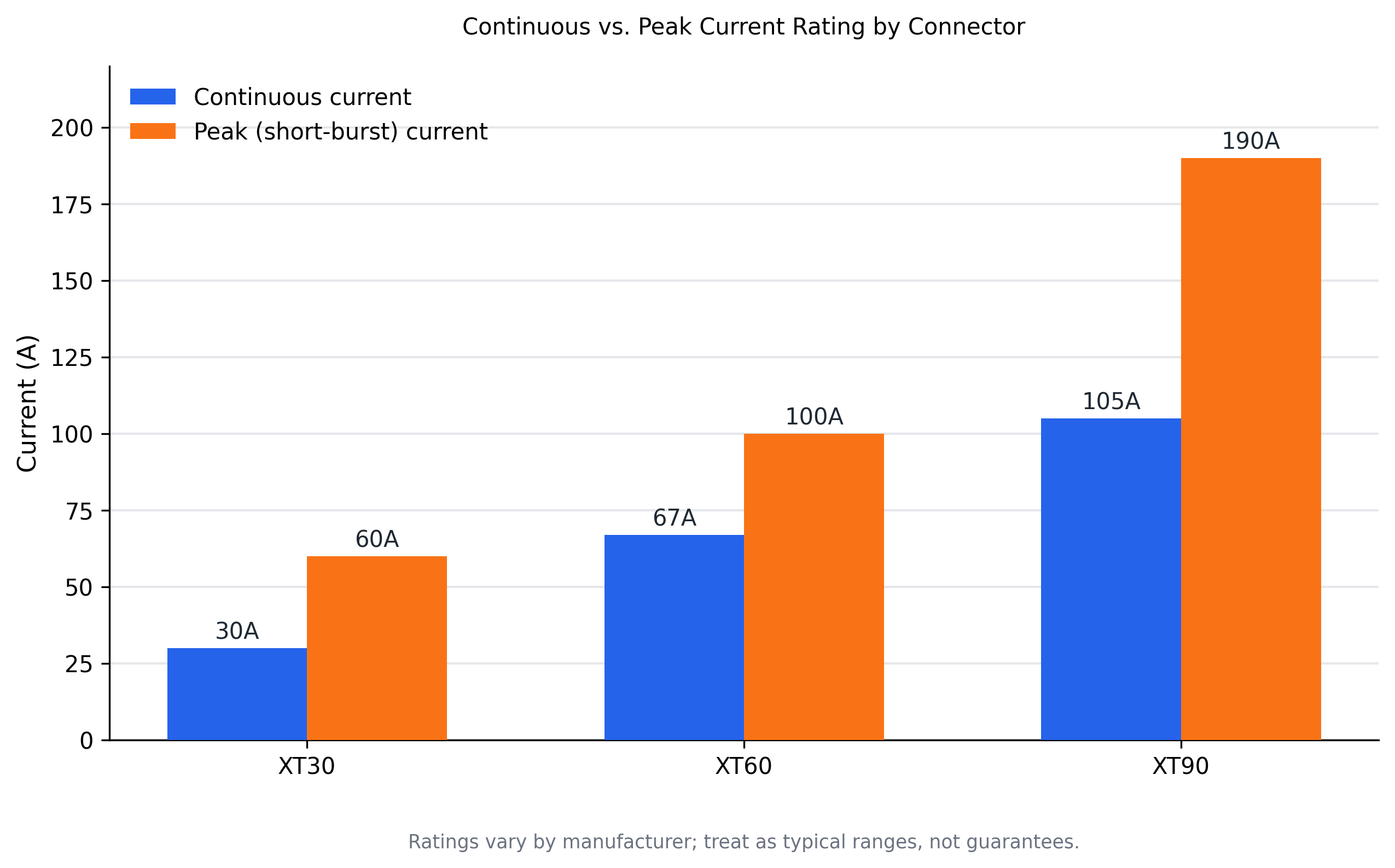
Figure 2. Typical continuous vs. peak current ranges across the XT30/60/90 family.
Why the Difference Actually Matters
Connector heating follows basic physics: power lost as heat rises with the square of the current for a given resistance, so pushing considerably more current through an undersized connector does not raise the temperature proportionally — it raises it much faster. That is why an XT60 asked to carry sustained loads well above its rating can soften its plastic housing, degrade its gold-plated contacts, or lose connection entirely, sometimes without obvious warning until it happens.
- Melted or deformed housings and oxidized contacts after repeated high-current cycles
- Voltage sag under load and intermittent connections, especially in vibration-heavy uses like e-bikes or RC vehicles
- A real fire risk in enclosed spaces such as tents, van conversions, or RV compartments
A common mistake is assuming an XT60-to-XT90 adapter “solves” a current problem. It does not: an adapter only changes the connector shape. The current-carrying capacity is still limited by whichever connector — and whichever wire gauge — is the weakest link in the chain.
How to Choose Between Them
- Add up your actual continuous and peak current draw first — do not choose a connector by eye.
- Staying under roughly 1,000–1,200 W of solar or battery throughput at typical system voltages usually keeps you comfortably within XT60 territory, and XT60 is lighter and cheaper.
- Parallel solar arrays above ~1,500 W, larger e-bike packs, or power stations in the 2,000–3,000 W+ class call for XT90 or the manufacturer's proprietary high-current port.
- Match wire gauge to the connector rating — a high-current connector soldered to thin wire gains you nothing.
- Choose anti-spark variants (XT60H/XT90S) for any setup you will connect or disconnect under load, since they suppress the arcing that pits contacts over time.
Part 2. How to Choose a Portable Power Station
Start With Watt-Hours (Wh) and Watts (W) — Not Just “Size”
Watt-hours (Wh) are the fuel tank: total stored energy. Watts (W) are the engine: how much power the unit can deliver at any given instant. A common mistake is comparing units on capacity alone and ignoring output wattage, or vice versa.
Rough runtime formula: hours ≈ capacity (Wh) × 0.8 ÷ your load (W). The 0.8 factor accounts for real-world inverter and conversion losses. List every device you intend to run at the same time and add up the wattage before you shop by capacity alone.
Match the Inverter to Your Appliances
- Continuous watts: what the unit can output steadily — this must exceed your total simultaneous load.
- Surge / peak watts: whether motor-driven devices (compressor fridges, water pumps, power tools) can even start; these often demand 2–3× their running wattage for a fraction of a second.
- A pure sine wave inverter is now the baseline expectation — avoid modified sine wave units if you plan to run sensitive electronics, CPAP machines, or motor-driven appliances.
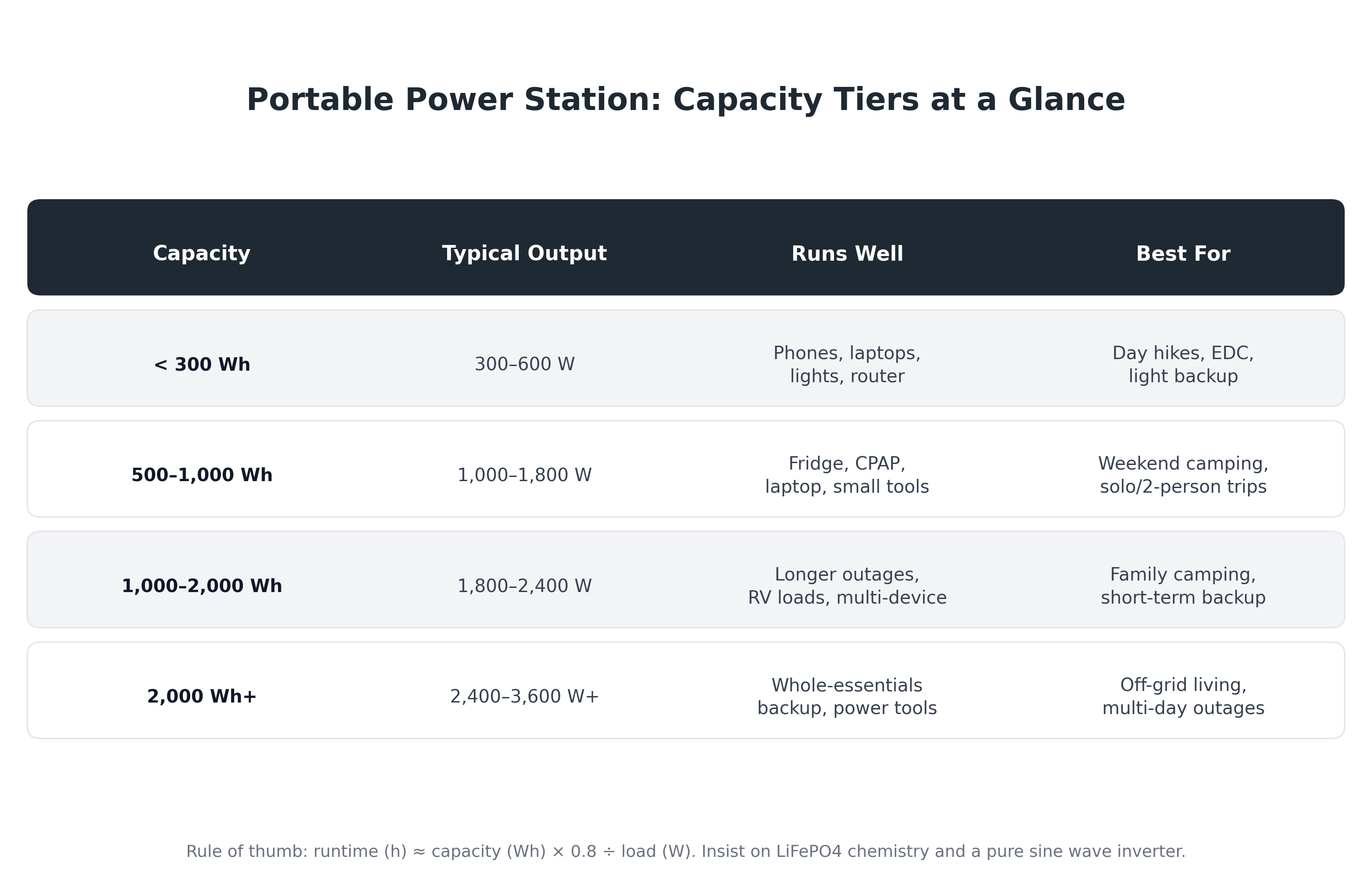
Figure 3. Capacity tiers, typical output, and best-fit use cases for portable power stations.
Battery Chemistry: Insist on LiFePO4
- LiFePO4 (LFP) cells dominate the market by 2026: roughly 3,000–4,000+ charge cycles to 80% capacity, versus 500–800 cycles for older NMC lithium-ion packs.
- LFP chemistry is more thermally stable, with a meaningfully lower thermal-runaway risk — relevant if the unit will live in a tent, van, or bedroom.
- The trade-off is a slightly heavier pack per watt-hour, but the multi-year lifespan advantage makes LFP the better long-term value in nearly every case.
Charging Inputs — Where XT60/XT90 Come Back Into Play
- Three charging paths are worth having: fast AC wall charging (many current units reach 80% in well under an hour), 12V car charging, and solar (MPPT) input.
- Solar input connectors vary a great deal by brand and model. Many stations under roughly 1,500 W use XT60; larger units often step up to XT90, Anderson-style connectors, or a proprietary aviation-style plug. Always confirm your exact model's port type and voltage/current window before buying cables or panels.
- Over long solar cable runs, wire gauge matters as much as connector type — thin wire on a long run can waste more than 10% of harvested solar power as heat.
Portability, Climate, and Other Practical Factors
- Every added watt-hour adds weight; decide up front whether the unit will live in a closet, ride in a vehicle, or be carried to a campsite.
- Most LiFePO4 units should not be charged below freezing (roughly 0°C / 32°F) even though they discharge safely in cold weather — warm the unit before charging it in winter.
- UPS/EPS switchover speed matters if you are protecting a router, modem, medical device, or desktop computer during outages — look for a transfer time under about 20 milliseconds.
- Expandable battery systems let you start with a smaller base unit and add capacity later, which is often more cost-effective than over-buying on day one.
A Quick Buying Checklist by Use Case
|
Use Case |
Recommended Spec |
|
Weekend / solo camping |
~500–1,000 Wh, 1,000–1,800 W inverter, XT60 solar input, LiFePO4 |
|
Family camping / short RV trips |
~1,000–2,000 Wh, 1,800–2,400 W inverter, fast AC recharge |
|
Home backup / off-grid living |
2,000 Wh+, 2,400–3,600 W+ inverter, XT90 or proprietary high-current solar input, expandable battery packs, UPS mode |
Conclusion
XT60 and XT90 look nearly identical but are built for very different current ranges. Treat the model number as a rough continuous-amperage rating, and size the connector to your actual current draw — not the other way around. The same underlying logic carries over to choosing a portable power station: match watt-hours and inverter wattage to what you will actually run, insist on LiFePO4 chemistry and a pure sine wave inverter, and confirm exactly which solar connector your chosen model uses before ordering cables or panels.
Note: figures above reflect typical industry ranges as of September 2026 and vary by manufacturer. Always check the exact datasheet for your specific connector or power station model before making purchasing or wiring decisions.