

What Does the BMS in a Portable Power Station Actually Do?
What Does the BMS in a Portable Power Station Actually Do?
From cell protection to new compliance rules: a plain-English guide to the “brain” of an outdoor power station
Technical explainer · November 10, 2026
|
Key takeaway The BMS (Battery Management System) is the electronics that “watch over every cell” in a portable power station: it continuously measures voltage, current and temperature, cuts the circuit when something goes wrong, keeps the cells consistent with one another, and estimates how much energy is left. It does not decide how many watt-hours the battery holds, but it decides whether those watt-hours can be used safely, for years, and reliably. With China’s mandatory standard GB 47372—2026 published (effective April 1, 2027), the BMS is shifting from a nice-to-have to a hard compliance requirement. |
1. What is a BMS: the “brain, fuse and housekeeper”
A portable power station’s battery pack is built from dozens of cells, or more, connected in series and parallel. No two cells are perfectly identical, and lithium cells are sensitive to overcharge, over-discharge, overcurrent and extreme temperatures. One cell drifting out of range can drag down the whole pack or even cause a safety incident.

Figure 1 Typical architecture of a portable power station BMS (schematic)
The BMS is the electronics that keeps an eye on those cells. A typical BMS combines a voltage/temperature sampling chip (AFE), a main controller (MCU), charge/discharge switches (MOSFETs or relays) and a current-sensing element, and it talks over CAN, UART or Bluetooth to the inverter, the MPPT solar charger, the display and the phone app (Figure 1).
2. Five core functions
|
Function |
What the BMS does |
Why it matters |
|
Protection |
Monitors over-/under-voltage, overcurrent, short circuit, over-temperature and low-temperature charging; cuts the circuit when needed |
Prevents fire, swelling and permanent cell damage |
|
Balancing |
Narrows the charge gap between series-connected cells |
More usable capacity, longer life |
|
State estimation |
Estimates SOC (remaining charge) and SOH (state of health) |
More accurate gauge, early warning of aging |
|
Communication & control |
Exchanges data with the inverter, solar charger and app, and limits power when needed |
Stable output, remote monitoring |
|
Logging & traceability |
Stores abnormal events and key parameters |
Easier fault diagnosis; required by the new standard |
2.1 Protection: keeping cells inside a “safety window”
For LiFePO4, BMS-vendor material quotes typical limits of about 3.60–3.65 V per cell for over-voltage, about 2.8–3.0 V for under-voltage, and roughly 45–55 °C for over-temperature; the exact values depend on the cell datasheet (Figure 2). The BMS also handles overcurrent and short circuits, and it blocks charging of LiFePO4 cells at sub-freezing temperatures, and some models add self-heating. That is why solar charging sometimes refuses to start on a frozen morning.
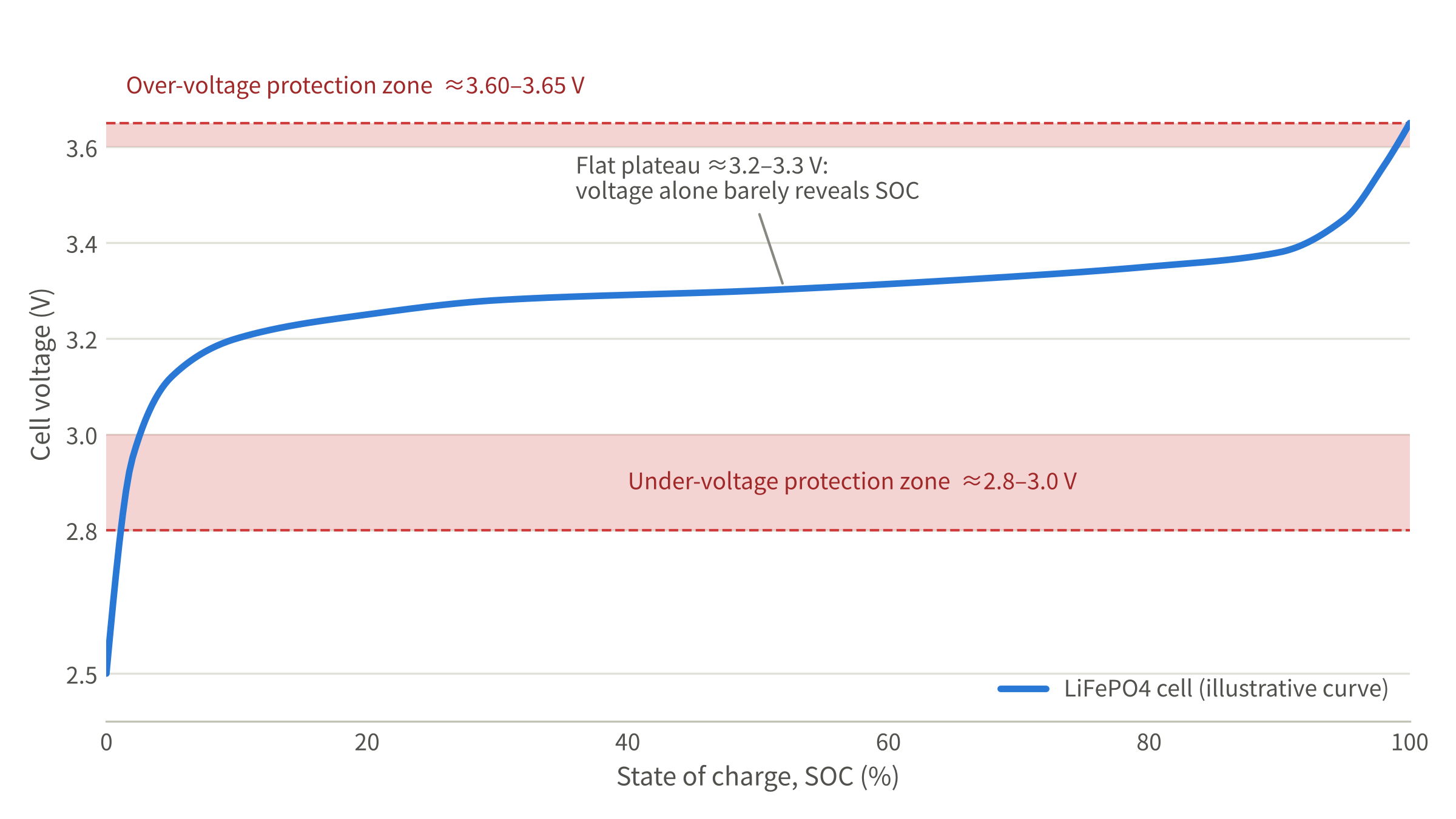
Figure 2 LiFePO4 cell voltage and protection thresholds (illustrative curve; thresholds are typical values quoted by BMS vendors)
2.2 Balancing: so the weakest cell stops holding everyone back
In a series string, the weakest cell sets the usable capacity of the whole pack: when it fills first, charging must stop; when it empties first, discharging must stop (Figure 3). Balancing narrows that gap. Passive balancing burns off the excess charge of higher-voltage cells through resistors; it is cheap and suits small, well-matched packs. Active balancing moves energy to the lower cells; industry material cites balancing currents of roughly 1–5 A, which suits large-capacity or high-discharge systems.
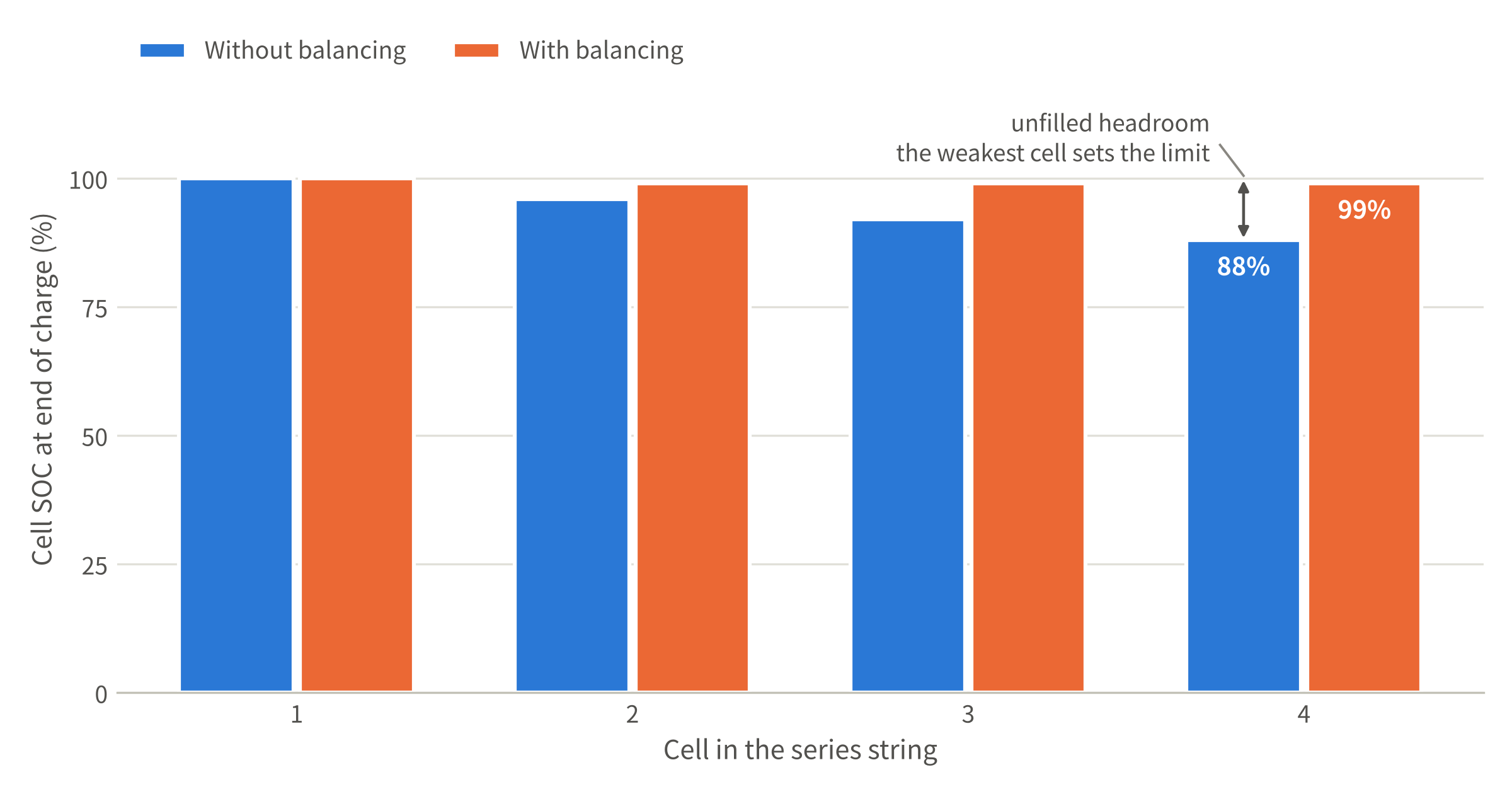
Figure 3 Effect of balancing on each cell’s SOC at the end of charge (illustrative data)
2.3 State estimation: where the “remaining %” comes from
The percentage on the screen is not measured directly. The BMS estimates it by integrating current (coulomb counting) and correcting with voltage and temperature. The LiFePO4 voltage curve is very flat through the middle (see Figure 2), so voltage alone says little about charge, which is why algorithm quality decides whether you get a “30% left, then sudden shutdown” experience. SOH tracks capacity fade and is used to anticipate end of life.
2.4 Communication and control: the translator between battery and machine
The BMS tells the inverter and the solar charger what charge/discharge current is currently allowed and what state the battery is in, derates or cuts the output when necessary, and manages pre-charge so that the inverter’s large capacitors do not draw an inrush current at start-up. The 2026 industry trend is intelligence: real-time app monitoring and remote control are increasingly common, and AI-driven energy management is starting to appear.
2.5 Logging and traceability: so problems can be investigated
The BMS also records abnormal events. The latest national standard writes this into its requirements: key parameters such as voltage and temperature must be monitored in real time, and products must be able to store and read out abnormal-event information.
3. Latest news: regulations and battery technology
China: GB 47372—2026 and the revised CCC rules
- Standard published: On April 3, 2026, China published the mandatory national standard Safety Technical Specification for Power Banks (GB 47372—2026), drafted under the Ministry of Industry and Information Technology. It takes effect on April 1, 2027, with a 12-month transition period, and covers both power banks and portable energy-storage power supplies (outdoor power stations).
- Requirements tied directly to the BMS: real-time monitoring of key parameters such as voltage and temperature; storage and read-out of abnormal information; a new needle-penetration test and a lithium-plating check after cycle aging; a unique product code; and a recommended safe service life marked on the product.
- New CCC rules: On May 25, 2026, the State Administration for Market Regulation issued revised CCC implementation rules. CCTV reported that the first 32 certificates under the new rules had been issued by September; products certified under them must offer smart management, voltage regulation and abnormal-disable functions. From April 1, 2027, products leaving the factory for sale must be certified under the new rules.
- Units already bought: Compliant products that already hold CCC certification can continue to be owned and used.
International: UL 2743 gets an upgrade
North America’s ANSI/CAN/UL 2743:2025 (3rd edition) was published on September 24, 2025. It adds coverage of sodium-ion batteries and includes functional-safety requirements. The standard also requires lithium-ion power packs above 1 kWh to pass a thermal propagation test and a single-cell-failure design-tolerance test per UL 1973. According to an Intertek standards update notice, certified products must move to the 3rd edition before its September 24, 2027 effective date.
Battery technology: LiFePO4 dominates, sodium-ion rises
In a SunSee survey of more than 100 portable power stations, 94% used LiFePO4, whose cycle life often reaches 3,000–4,000 cycles or more. Sodium-ion is the new variable: Bluetti’s Pioneer Na, unveiled at IFA 2025, offers 900 Wh and 1,500 W of output and is reported to charge at −15 °C and discharge at −25 °C, but sodium-ion energy density is still below LiFePO4 and supply is limited. For the BMS, different chemistries have different voltage windows, SOC curves and low-temperature strategies, so each needs its own calibration.
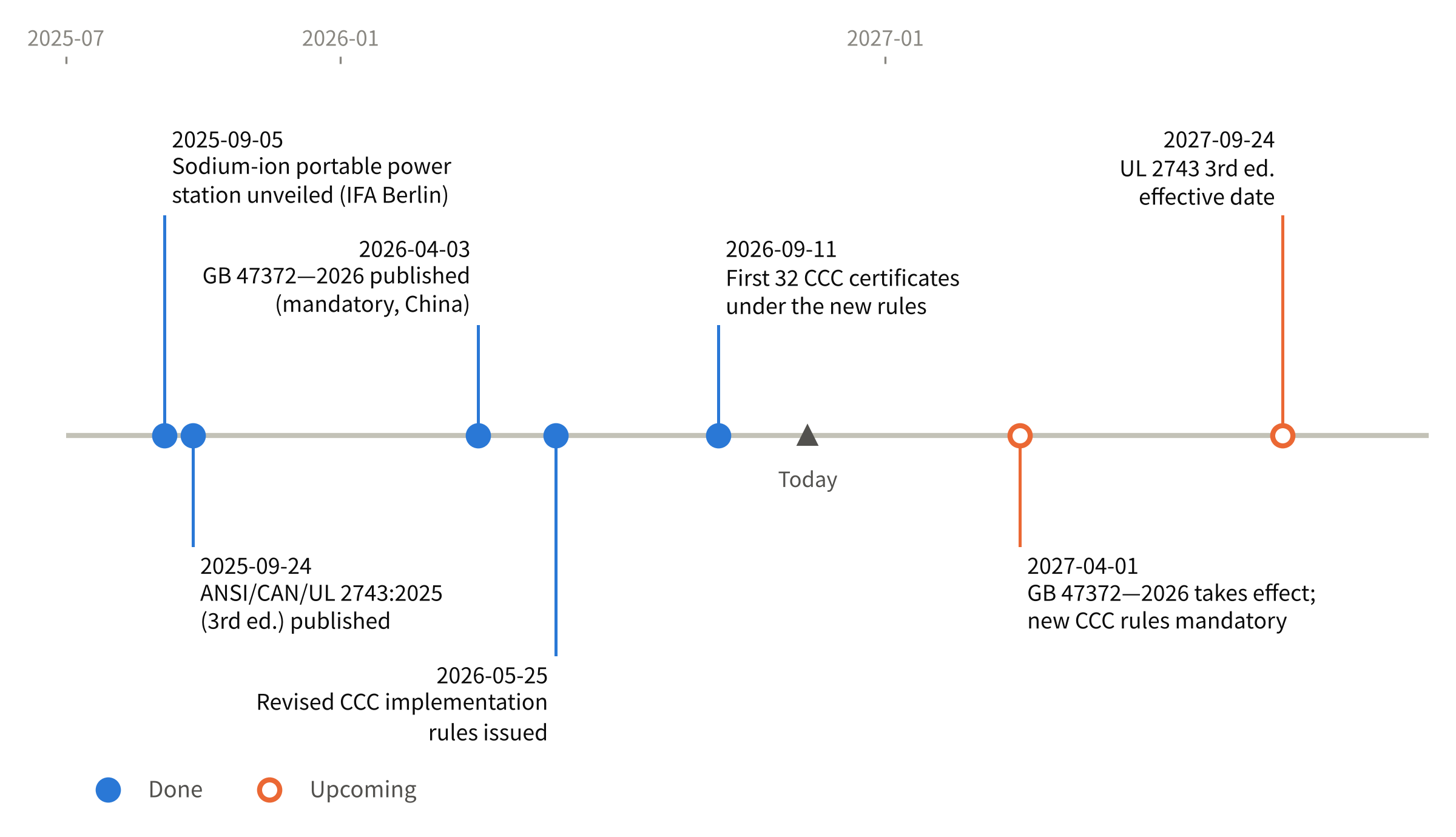
Figure 4 Key milestones for the relevant standards and products
4. Buying and usage tips
- Check compliance first: in China, look for the 3C/CCC mark and watch for certification under the new rules; for North America, look for UL 2743 certification.
- Look past capacity, look at the BMS: check that over-charge, over-discharge, overcurrent, short-circuit, over-temperature and low-temperature charging protection are specified, and whether the app shows per-cell voltage and fault records.
- Check the cell chemistry and life rating: chemistry (e.g., LiFePO4), rated cycle count and warranty terms.
- Winter and cold climates: understand the low-temperature charging limits, and consider models with self-heating or sodium-ion cells.
- Use it properly: avoid heat and impacts; stop using the unit immediately if it shows serious swelling.
Conclusion
Capacity and power decide what a power station can do; the BMS decides whether it can keep doing it safely. As the 2027 national standard and the revised CCC rules take effect, and sodium-ion and other new chemistries reach the market, BMS compute power, accuracy and data capability will increasingly set products apart. When shopping, asking “what does its BMS do?” is often worth more than comparing one more spec.
Notes
Figures 2 and 3 are schematic; the values illustrate principles and do not represent any specific product. Protection thresholds are cited from BMS-vendor material; always follow the cell datasheet and the product’s rated specifications. This article is based on public information available as of November 10, 2026; please refer to official publications for regulatory and product details.
Sources
- 新华网/人民日报 Xinhua / People's Daily — 充电宝、户外电源新标准出台 强化安全水平,设置12个月过渡期 (2026-04-04) https://www.news.cn/20260404/99cc68b882c147f988af13d9745ed82f/c.html
- 央视新闻 CCTV (via 新华财经 Xinhua Finance) — 新版充电宝3C认证实施规则落地 已发出首批32张3C认证证书 (2026-09-11) https://www.cnfin.com/hg-lb/detail/20260911/4468573_1.html
- 国家认监委公告 SAMR/CNCA notice (via 格隆汇 Gelonghui) — 3C认证实施规则迎来新调整 https://m.gelonghui.com/p/4990823
- ChargerLab — China's New Power Bank Standard GB 47372-2026 Looms (2026-06-24) https://www.chargerlab.com/chinas-new-power-bank-standard-gb-47372-2026-looms-ti-accelerates-battery-management-upgrades/
- ANSI Webstore — ANSI/CAN/UL 2743:2025 Portable Power Packs (published 2025-09-24) https://webstore.ansi.org/standards/ul/ansiul27432025
- Intertek Standards Update Notice — ANSI/CAN/UL 2743 (Rev. 9/24/2025, effective 9/24/2027) https://preview.intertek.com.ec/siteassets/resources/sun/2026/ansi-can-ul-2743-sun-rev-9-24-2025-ed-9-24-2027.pdf
- Intertek Standards Update Notice — ANSI/CAN/UL 2743 (effective 2025-10-04) https://w3inte.intertek-france.com/siteassets/resources/sun/2024/ansi-can-ul-2743-sun-rev-4-14-2023-ed-10-4-2025.pdf
- DALY BMS — 2026 Outdoor Portable Energy Storage Booms: LiFePO4 BMS Critical for Safety & Lifespan (2026-04-03, vendor material) https://www.dalybms.com/news/2026-outdoor-portable-energy-storage-booms-lifepo4-bms-critical-for-safety-lifespan
- SunSee (dev.to) — LiFePO4 won the power station wars, sodium-ion wants a rematch https://dev.to/sunsee/lifepo4-won-the-power-station-wars-sodium-ion-wants-a-rematch-14nk
- pv magazine — Bluetti unveils sodium-ion portable power station (IFA 2025) https://www.pv-magazine.com/?p=315862
- Bestforandroid — BLUETTI Bets on Smart Power Hubs Over Just Bigger Batteries https://bestforandroid.com/bluetti-integrated-energy-ecosystems/
- Market Research Future blog (mirror) — The Resilience Revolution: Portable Power Station Market Trends https://skynex.alwaysdata.net/blogs/175/The-Resilience-Revolution-Navigating-Portable-Power-Station-Market-Trends-with?lang=en_us